Japanese private companies are set to deepen their presence in India with nearly 120 cooperation agreements worth about $12.5 billion expected around the 16th India-Japan Annual Summit, giving Prime Minister Sanae Takaichi’s first official visit to New Delhi a strong economic and strategic focus.
The summit between Prime Minister Narendra Modi and Takaichi comes at a time when India and Japan are seeking closer cooperation in economic security, energy supply chains, maritime security, artificial intelligence, semiconductors and innovation. More than 150 Japanese companies are also participating in the Japan-India Economic Forum during the visit.
Advertisement
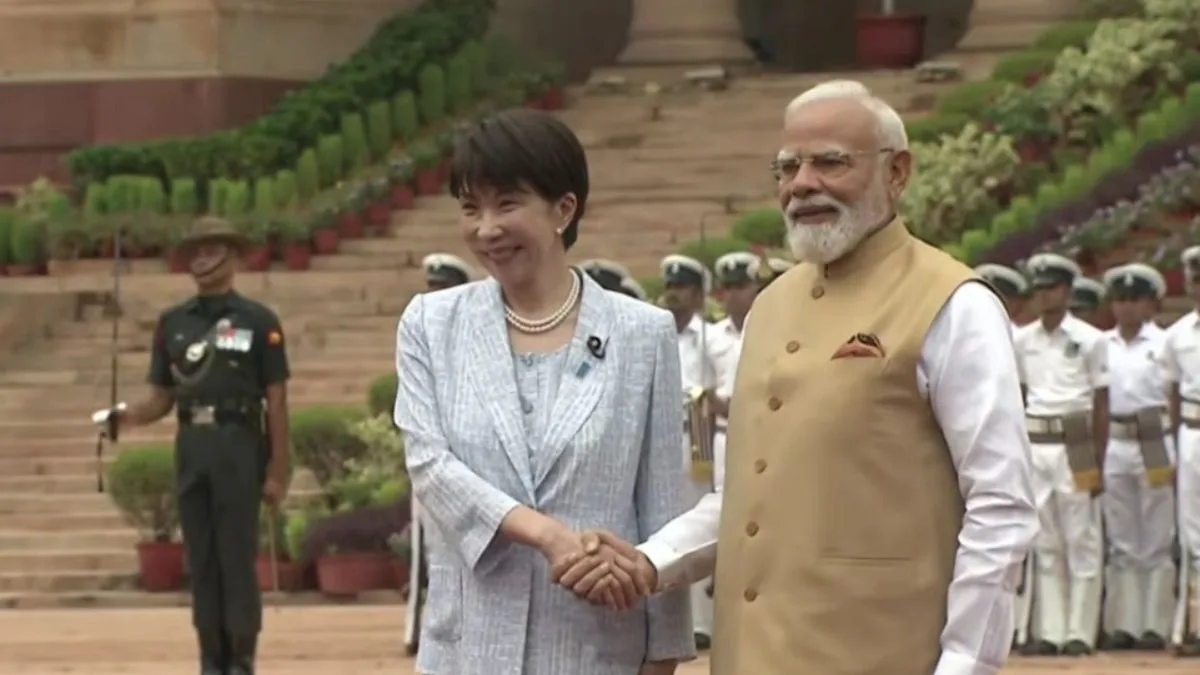
Takaichi, who arrived in New Delhi on Wednesday for a three-day official visit, was accorded a ceremonial welcome at Rashtrapati Bhavan on Thursday. Prime Minister Modi welcomed her on arrival at the forecourt.
Later in the day, PM Modi and Takaichi are scheduled to hold summit-level talks. The two leaders are expected to review the full range of bilateral cooperation and discuss regional and global issues of shared interest.
Japan’s Deputy Chief Cabinet Secretary Masanao Ozaki, who accompanied Takaichi to India, said the visit would strengthen government-to-government ties in areas such as security and economic security.
“On this occasion, over 150 Japanese companies will also participate, and the Japan-India Economic Forum will be held as well,” Ozaki wrote on X.
He said he hoped the visit would trigger “concrete and remarkable development” in Japan-India economic relations.
Japan’s $12.5 billion India investment push
According to Japanese newspaper The Yomiuri Shimbun, the initiatives are valued at about 2 trillion yen on the Japanese side. The report said they are aimed at expanding Japan’s footprint in India’s growing market.
The agreements are expected to cover several sectors. These include Fujifilm’s collaboration on a semiconductor materials plant, a Suzuki-backed biogas facility initiative, and application development partnerships between Japanese and Indian artificial intelligence startups.
The expected investment push is part of a wider bilateral target set last year. Under that commitment, Japanese private investment in India is aimed at reaching 10 trillion yen over ten years.
Maritime security, energy and AI on summit agenda
The draft joint statement, cited by The Yomiuri Shimbun, points to deeper cooperation on maritime security and energy security.
The document also refers to Japan’s updated operational guidelines on the transfer of defence equipment and notes ongoing maritime security cooperation between the two countries.
The two sides are also expected to convene a Japan-India Foreign and Defence Ministerial Meeting, known as the 2+2 dialogue, before the end of the year.
Energy security is another key item on the agenda. The draft statement refers to joint stockpiling initiatives to strengthen supply integrity.
The document also raises concern over China’s recent export curbs on rare earth elements. It refers to deep apprehensions over non-market policies and economic coercion.
Takaichi says India ties matter amid global uncertainty
Before leaving Tokyo, Takaichi said India’s role had become more important because of global uncertainty.
“Amid growing uncertainty in the international situation, the importance of collaboration with India, which shares fundamental values and strategic interests, is only increasing,” she said.
She said her visit would focus on three areas: deepening strategic cooperation, promoting economic security, and encouraging business collaboration in investment and innovation.
“By uniting government and private sectors, we aim to broaden the scope of Japan-India cooperation and realise a strong economy,” she said.
After arriving in Delhi, Takaichi said she looked forward to discussions with Modi on urgent issues, including economic security and energy security.
She said the two countries would work to deepen the Japan-India Special Strategic and Global Partnership in light of the current international situation.
PM Modi welcomes Takaichi on first India visit
Prime Minister Modi welcomed Takaichi to India and said he looked forward to wide-ranging talks.
“A very warm welcome to India, Prime Minister Sanae Takaichi. We are delighted to host you on your first visit to India and I look forward to our wide-ranging discussions tomorrow that will further deepen the India-Japan Special Strategic and Global Partnership,” Modi said in a post on X.
“Through our joint efforts, we will continue to advance peace, stability and prosperity in the Indo-Pacific and beyond,” he added.
Union Minister of State for Science and Technology Jitendra Singh received Takaichi at Palam Technical Airport on Wednesday evening.
India-Japan partnership expands across sectors
India and Japan elevated their relationship to a Special Strategic and Global Partnership in 2014.
Since then, the two countries have expanded cooperation in defence, infrastructure, trade, digital technologies, clean energy, mobility, healthcare and people-to-people exchanges.
During the current visit, both sides are also expected to discuss support for small and medium-sized enterprises entering the Indian market, improvements to India’s domestic business environment and cooperation on bringing JR East’s E10 series Shinkansen train to India.
The summit is also expected to give fresh momentum to technology cooperation. The draft statement says promoting innovation, including artificial intelligence, is important for expanding the foundation of bilateral cooperation.